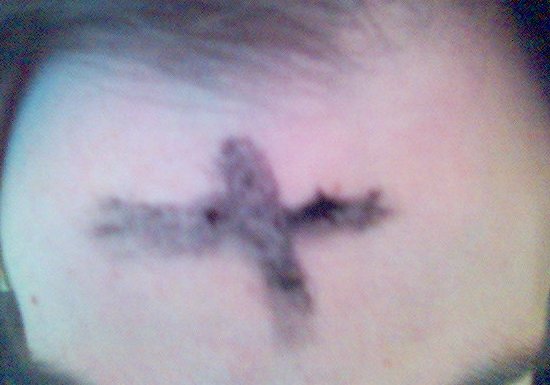
The purpose of Lent is the preparation of the believer—through prayer, penitence, almsgiving and self-denial—for the annual commemoration of the Death and Resurrection of Jesus, as celebrated during Holy Week, which recalls the events linked to the Passion of Christ and culminates in Easter, the celebration of the Resurrection of Jesus Christ.
In Western Christianity, Lent lasts from Ash Wednesday until Holy Saturday.[1] The six Sundays in Lent are not counted among the forty days because each Sunday represents a "mini-Easter", a celebration of Jesus' victory over sin and death.[2] In those churches which follow the Byzantine tradition (e.g. Eastern Orthodox and Eastern Catholics), the forty days of Lent are calculated differently: the fast begins on Clean Monday, Sundays are included in the count, and it ends on the Friday before Palm Sunday. The days of Lazarus Saturday, Palm Sunday and Holy Week are considered a distinct period of fasting. For more detailed information about the Eastern Christian practice of Lent, see the article Great Lent.
Origins
The forty-day period is symbolic of the 40 days spent by Jesus in the desert. The number forty has many other Biblical significances: the forty days Moses spent on Mount Sinai with God; the forty days and nights Elijah spent walking to Mount Horeb; God made it rain for forty days and forty nights in the days of Noah; the Hebrew people wandered forty years traveling to the Promised Land; Jonah in his prophecy of judgment gave the city of Nineveh forty days time in which to repent.
Jesus retreated into the desert, where he fasted for forty days, and was tempted by the devil. Jesus overcame all three of Satan's temptations by citing scripture to the devil, at which point the devil left him, angels ministered to Jesus, and he began his ministry.
It was also traditional belief that Jesus lay for 40 hours (instead of the biblical three days) in the tomb,[3] which led to to the forty hours of total fast that preceded the Easter celebration in the early Church.[4] The main ceremony was the baptism of the initiates on Easter Eve. The fast was in preparation to receive this sacrament. Later, the period from Good Friday until Easter Day was extended to six days, to correspond with the six weeks of training, necessary to instruct the converts who were to be baptized.
Converts to Christianity followed a strict catechumenate or period of instruction and discipline. In Jerusalem near the close of the fourth century, classes were held throughout Lent for three hours each day. With the legalization of Christianity (by the Edict of Milan) and its later imposition as the state religion of the Roman Empire, its character was endangered by the great influx of new members. In response, the Lenten fast and practices of self-renunciation were required annually of all Christians. The less zealous of the converts were thus brought more securely into the Christian fold.
Traditionally, on Easter Sunday, Roman Catholics may cease their fasting and start again whatever they gave up for lent, after they attend Sunday mass. Other Western denominations have also followed this general principle to a greater or lesser degree.
[edit] Name
In the English language, Lent was formerly referred to by the Latin term quadragesima (translation of the original Greek tessarakoste, the "fortieth day" before Easter). This nomenclature is preserved in Romance, Slavic and Celtic languages (for example, Spanish cuaresma, Portuguese quaresma, French carême, Italian quaresima, Croatian korizma, Irish Carghas, and Welsh C(a)rawys).
In the late Middle Ages, as sermons began to be given in the vernacular instead of Latin, the English word lent was adopted. This word initially simply meant spring and derives from the Germanic root for spring (specifically Old English lencten; also the Anglo-Saxon name for March—lenct—as the main part of Lent, before Easter, usually occurred in March). In modern Dutch, the word for "spring" is still "lente", while the 40-days fasting period is called "vasten". The use of this particular term to describe the period at this point is unique to English.
[edit] Customs during the time of Lent
There are traditionally forty days in Lent which are marked by fasting, both from foods and festivities, and by other acts of penance. The three traditional practices to be taken up with renewed vigour during Lent are prayer (justice towards God), fasting (justice towards self), and almsgiving (justice towards neighbour). Today, some people give up something they enjoy, add something that will bring them closer to God, and often give the time or money spent doing that to charitable purposes or organizations.[5]
In many liturgical Christian denominations, Maundy Thursday (also called "Holy Thursday," especially by Roman Catholics), Good Friday, and Holy Saturday form the Easter Triduum. Lent is a season of grief that necessarily ends with a great celebration of Easter. It is known in Eastern Orthodox circles as the season of "Bright Sadness." It is a season of sorrowful reflection which is punctuated by breaks in the fast on Sundays.
The Lenten semi-fast may have originated for practical reasons: during the era of subsistence agriculture in the West as food stored away in the previous autumn was running out, or had to be used up before it went bad in store, and little or no new food-crop was expected soon (compare the period in Spring which British gardeners call the "hungry gap").
In the Roman Catholic Mass, Lutheran Divine Service, and Anglican Eucharist, the Gloria in Excelsis Deo is not sung during the Lenten season, disappearing on Ash Wednesday and not returning until the moment of the Resurrection during the Easter Vigil. On major feast days, the Gloria in Excelsis Deo is recited, but this in no way diminishes the penitential character of the season; it simply reflects the joyful character of the Mass of the day in question. It is also used on Maundy Thursday. Likewise, the Alleluia is not sung during Lent; it is replaced before the Gospel reading by a seasonal acclamation.
Traditionally, the Alleluia was omitted at Mass beginning at Septuagesima, but in the Missal of Paul VI (1969) promulgated after the Second Vatican Council it is retained it until Ash Wednesday. The older practise is retained in the Missal of John XXIII (1962) which is attended by traditionalists.
In the Byzantine rites, the Gloria (Great Doxology) continues to be used in its normal place in the Matins service, and the Alleluia appears all the more frequently, replacing "God is the Lord" at Matins.
Pre-Lenten festivals


Although originally of pagan content, the traditional carnival celebrations which precede Lent in many cultures have become associated with the season of fasting if only because they are a last opportunity for excess before Lent begins. The most famous of pre-Lenten carnivals in the West is Shrove Tuesday or Mardi Gras.
[edit] Fasting and abstinence
Fasting during Lent was more severe in ancient times than today. Socrates Scholasticus reports that in some places, all animal products were strictly forbidden, while others will permit fish, others permit fish and fowl, others prohibit fruit and eggs, and still others eat only bread. In some places, believers abstained from food for an entire day; others took only one meal each day, while others abstained from all food until 3 o'clock. In most places, however, the practice was to abstain from eating until the evening, when a small meal without meat or alcohol was eaten.
During the early Middle Ages, meat, eggs and dairy products were generally proscribed. Thomas Aquinas argued that "they afford greater pleasure as food [than fish], and greater nourishment to the human body, so that from their consumption there results a greater surplus available for seminal matter, which when abundant becomes a great incentive to lust."[6]
However, dispensations for dairy products were given, frequently for a donation, from which several churches are popularly believed to have been built, including the "Butter Tower" of the Rouen Cathedral. In Spain, the bull of the Holy Crusade (renewed periodically after 1492) allowed the consumption of dairy products[7] and eggs during Lent in exchange for a contribution to the war against Islam.
Giraldus Cambrensis in his Itinerary of Archbishop Baldwin through Wales reports that "in Germany and the arctic regions," "great and religious persons," classified the tail of beavers as "fish" because of its superficial resemblance to a fish and their relative abundance.
Today, in the West, the practice is considerably relaxed, though in the Eastern Orthodox, Oriental Orthodox and Eastern Catholic Churches abstinence from the above-mentioned food products is still commonly practiced, meaning only vegetarian meals are consumed during this time in many Eastern countries. Lenten practices (as well as various other liturgical practices) are more common in Protestant circles than they once were. In the Roman Catholic Church it is tradition to abstain from meat every Friday for the duration of Lent, although fish and dairy products are still permitted. On Ash Wednesday it is customary to fast for the day, with no meat, eating only one full meal, and if necessary, two small meals also.[8]
Current fasting practice in the Roman Catholic Church binds persons over the age of 14 and younger than fifty-nine (Canon 1251). Pursuant to Canon 1253, days of fasting and abstinence are set by the national Episcopal conference. On days of fasting, one eats only one full meal, but may eat two smaller meals as necessary to keep up one's strength. The two small meals together must sum to less than the one full meal. Parallel to the fasting laws are the laws of abstinence. These bind those over the age of eighteen. On days of abstinence, the person must not eat meat or poultry. According to canon law, all Fridays of the year, Ash Wednesday and several other days are days of abstinence, though in most countries, the strict requirements of abstinence have been limited by the bishops (in accordance with Canon 1253) to the Fridays of Lent and Ash Wednesday. On other abstinence days, the faithful are invited to perform some other act of penance.
Many modern Protestants consider the observation of Lent to be a choice, rather than an obligation. They may decide to give up a favorite food or drink (e.g. chocolate, alcohol) or activity (e.g. going to the movies, playing video games) for Lent, or they may instead decide to take on a Lenten discipline such as devotions, volunteering for charity work, and so forth. Roman Catholics may also observe Lent in this way, in addition to the dietary restrictions outlined above, though observation is no longer mandatory under the threat of mortal sin. Many Christians who choose not to follow the dietary restrictions cite 1 Timothy 4:1-5 which warns of doctrines that "forbid people to marry and order them to abstain from certain foods, which God created to be received with thanksgiving by those who believe and who know the truth."
| Liturgical year |
|---|
| Western |
| Eastern |
During The Troubles in Northern Ireland, breaking the fast was equated with the Loyalist movement and was perceived as a hate crime.[citation needed]
[edit] Holy Days
There are several holy days within the season of Lent.
- Ash Wednesday is the first day of Lent in Western Christianity.
- Clean Monday (or "Ash Monday") is the first day in Eastern Orthodox Christianity.
- The fourth Lenten Sunday, which marks the halfway point between Ash Wednesday and Easter, is sometimes referred to as Laetare Sunday, particularly by Roman Catholics.
- The fifth Lenten Sunday, also known as Passion Sunday (however, that term is also applied to Palm Sunday) marks the beginning of Passiontide.
- The sixth Lenten Sunday, commonly called Palm Sunday, marks the beginning of Holy Week, the final week of Lent immediately preceding Easter.
- Wednesday of Holy Week is known as Spy Wednesday to commemorate the days on which Judas spied on Jesus in the garden of Gethsemane before betraying him.
- Thursday is known as Maundy Thursday, or Holy Thursday, and is a day Christians commemorate the Last Supper shared by Christ with his disciples.
- Good Friday follows the next day, on which Christians remember His crucifixion and burial.
- In the Roman Catholic Church, Mass is a three day event called the Easter Triduum that begins with the opening song of the Holy Thursday celebration. After the Holy Thursday celebration, the communion bread and wine is taken from the altar with no formal closing. Instead, the parish is invited to worship the (holy Body of Christ). The next day is the official commemoration of The Passion of Jesus Christ and is usually celebrated at 3 PM local time though some parishes usually change the time due to work schedules. This commemoration is part of the Triduum Mass which the opening is just a prayer followed by the day's readings. The service usually ends with a shortened communion involving only the Body of Christ and a post communion prayer before the service ends without dismissal. The Easter Vigil is the start of the end of the Triduum mass and usually starts with a fire service before the readings which explore the history of mankind. The service also includes baptism and confirmation services which are usually celebrated after the homily. The Easter Vigil and Triduum Mass ends in the usual way with full communion.
Holy Week and the season of Lent, depending on denomination and local custom, end with Easter Vigil at sundown on Holy Saturday or on the morning of Easter Sunday. It is custom for some churches to hold sunrise services which include open air celebrations in some places.
In the Roman Catholic, Lutheran, and Anglican traditions, the altar linens and priest's vestments are violet during the season of Lent. However, during the holy days the linens often change. See Liturgical colours.
There are some Christian denominations that do not practice Lent and see it as an obscure tradition that the Church practices without Biblical merit.[9]